Botox injections rank among the most commonly performed non-surgical cosmetic procedures available today. Many people have them every year, yet most first-timers arrive at their consultation carrying a mix of myths, Instagram expectations, and half-understood facts. That's not a criticism. It's just the reality of an industry that moves fast and doesn't always pause to explain itself properly.
This guide cuts through the noise. You'll find out what botulinum toxin actually does inside your body, what the procedure involves from start to finish, how long results realistically last, what risks are worth knowing about, and how to tell a qualified, clinically led clinic from someone who took a weekend course and bought a syringe. Clinics like MAK Clinic in Knutsford, Cheshire are built around a consultation-first model, where clinical assessment comes before any treatment decision. That approach is less common than it should be, and by the end of this guide, you'll understand exactly why it matters.
What Botox Injections Actually Are
The short version: a purified neurotoxin
Botox is a brand name, not a generic term. The active ingredient is onabotulinumtoxinA, a highly purified form of botulinum toxin type A derived from the bacterium Clostridium botulinum. Botox Cosmetic (manufactured by Allergan) is the most widely recognised product, but it isn't the only option. Dysport and Xeomin are also botulinum toxin type A injectables approved for similar uses. These are sometimes called neuromodulator injections, and botox injections are the most recognisable form. When people say "Botox," they usually mean any of these products. Clinicians use the terms more precisely. If you'd like a deeper comparison, see Are Anti-Wrinkle Injections the Same as Botox?
How it stops muscles from contracting
The mechanism is specific and temporary. When injected into a targeted muscle, the toxin binds to the nerve terminal at the neuromuscular junction and blocks the release of acetylcholine, the chemical signal that tells a muscle to contract. Without that signal, the muscle relaxes. The underlying cellular action involves cleavage of a protein called SNAP-25, which prevents the vesicles carrying acetylcholine from fusing with the nerve membrane. For a concise, authoritative overview of the molecular mechanism and clinical pharmacology, see this review of botulinum toxin. When correctly dosed and placed, the result is controlled, localised muscle relaxation. Diffusion beyond the target site, which can cause unwanted effects like ptosis or asymmetry, is a direct consequence of poor technique or incorrect dosing rather than a property of the treatment itself.
Why the effect wears off over time
Nerve terminals regenerate. Over roughly three to six months, new nerve sprouts form at the neuromuscular junction and gradually restore normal muscle activity. This is why results are temporary and why repeat appointments are part of the process. It's not a sales tactic; it's biology. The muscle eventually receives signals again, expression lines return, and treatment is needed to maintain the result.
What Botox Injections Are Actually Used For
The cosmetic indications most people know
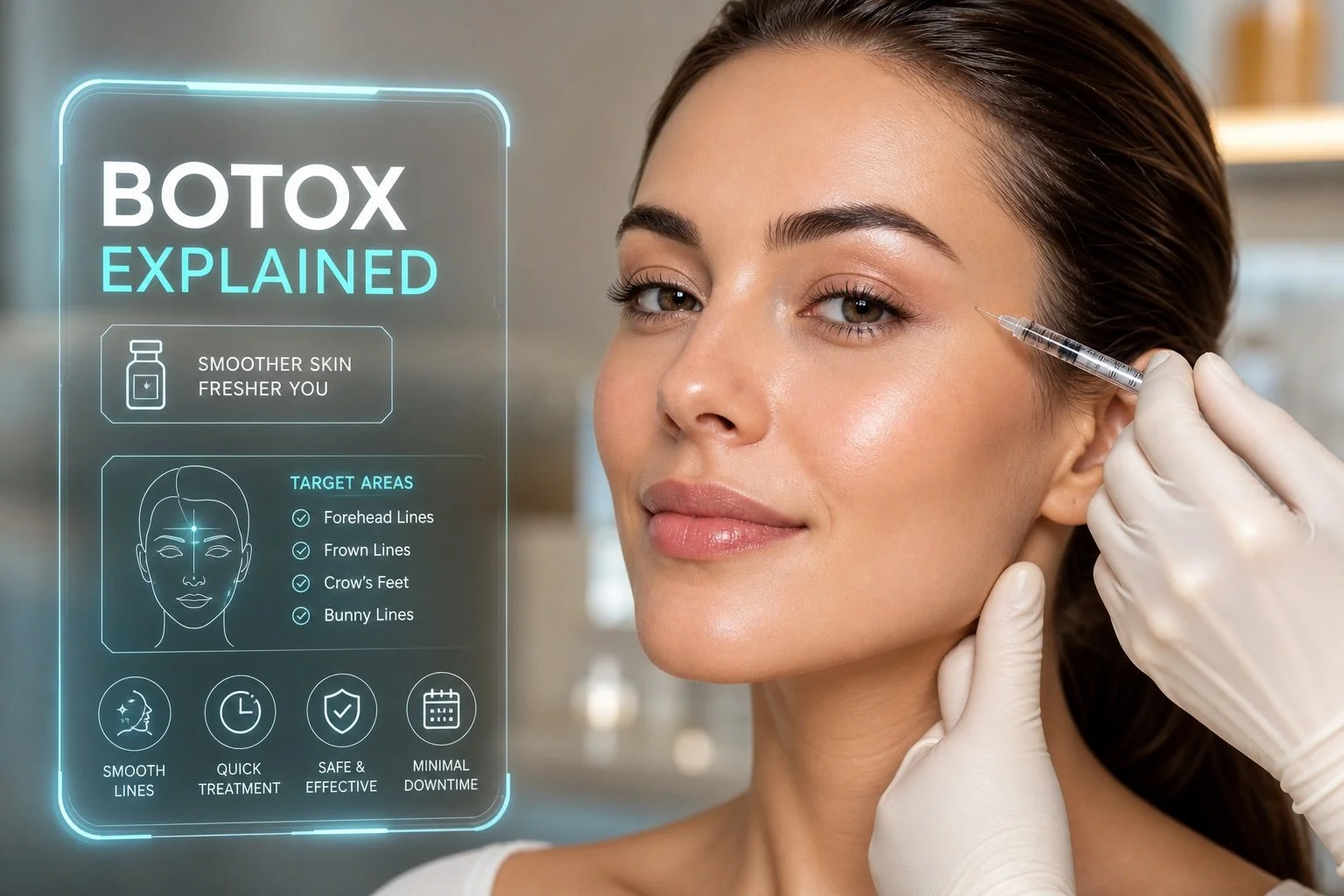
The cosmetic uses with the strongest evidence base are forehead lines, glabellar lines (the vertical "11s" between the eyebrows), crow's feet around the outer eyes, and platysma bands in the neck. These areas share a common characteristic: the lines are caused by repeated muscle movement rather than sun damage or volume loss. They're called dynamic wrinkles. Botulinum toxin treats expression lines specifically. It won't address static lines that appear at rest, and it isn't a substitute for dermal fillers when the issue is lost volume.
The medical applications that surprise most people
Most people associate these injections with aesthetics, but the therapeutic applications are extensive. Botox has over twelve FDA-approved medical indications, including chronic migraine prevention (for patients with fifteen or more headache days per month), primary axillary hyperhidrosis (severe underarm sweating), overactive bladder, cervical dystonia, and upper and lower limb spasticity. Migraine treatment alone uses 155 units across 31 injection sites on the head, neck, and shoulders, as set out in the PREEMPT protocol and the FDA-approved prescribing information for onabotulinumtoxinA. That's a very different protocol from cosmetic treatment, with different dosing, deeper injections, and a neurologist or headache specialist involved. For an authoritative clinical summary of botulinum toxin use in migraine, see Botulinum toxin injectables for migraines from Johns Hopkins Medicine.
Botox, Dysport, and Xeomin: what's actually different
All three are botulinum toxin type A, and all last roughly three to four months. The differences are formulation-based. Dysport contains smaller molecules, spreads wider, and tends to act faster at one to three days, making it well-suited for larger areas like the forehead. Xeomin is a "naked" toxin with no accessory proteins, which some practitioners prefer for patients who've developed resistance to other formulations. Botox Cosmetic has the longest track record and the most published data. Your provider's preference and your anatomy should guide the choice, not marketing.
What to Expect During Your Appointment
Before the injections start
A properly run appointment begins with a clinical consultation, not a treatment. The clinician reviews your medical history, current medications, any allergies, and what you actually want to achieve. This isn't paperwork for paperwork's sake. It determines where to inject, how much to use, and whether treatment is appropriate at all. Preparation on your end is simple: arrive with a clean face, avoid alcohol and blood-thinning medications like aspirin or ibuprofen for 24 to 48 hours beforehand, and eat normally before your appointment.
The injection process itself
The injections typically take ten to fifteen minutes. A fine needle is used at targeted sites, and most people describe the sensation as a brief, sharp pinch. Ice or topical numbing cream can be applied beforehand if you're concerned about discomfort. The number of injections varies depending on which areas are being treated and your individual anatomy. There is no universal number. First-time patients are usually treated conservatively, using a lower dose to allow for natural movement and to assess how your muscles respond before committing to a fuller result. For practical patient-facing guidance on what to expect during a Botox appointment, the Cleveland Clinic provides a useful resource on botulinum toxin injections covering preparation and aftercare.
What to do (and avoid) right after
The aftercare rules are straightforward. Don't rub or massage the treated area, don't lie flat for four to six hours, and skip intense exercise that day. These precautions prevent the product from migrating away from the intended injection site. You'll start noticing initial softening in three to five days. Full results show at ten to fourteen days. There's no significant downtime, though you may have mild redness or a small bruise at the injection site for a day or two.
How Long Results Last and What Changes That
The typical timeline from first injection to fade
The result arc is consistent across most patients. Initial softening appears at three to five days, peak results at ten to fourteen days, and gradual fading occurs between three and four months on average. Based on clinical observations across aesthetic medicine practice, roughly half of patients see results last three to four months, with the remainder split between longer and shorter durations. First-time patients often fall into the shorter end of that range and see longer-lasting results after subsequent treatments as the muscle gradually weakens through repeated use. For an overview of outcomes and duration reported in clinical studies, a recent open-access review summarises factors that affect longevity and patient response in more detail.
The factors that speed results up or slow them down
Duration is not fixed. Metabolism plays the biggest role: athletes and people with naturally fast metabolisms process botulinum toxin faster, which shortens how long results last. Muscle strength matters too. A strong, frequently used muscle will break down the effect more quickly than a less active one. Dosage, treatment area, and treatment history all feed into the timeline. Lifestyle habits like smoking and sun exposure accelerate the fade. Regular, well-timed maintenance appointments lead to progressively longer-lasting results for most patients.
Side Effects, Risks, and What the Red Flags Look Like
What's common and expected
The most predictable post-treatment reactions are mild and short-lived: redness, minor swelling, bruising, or a brief headache lasting 24 to 48 hours. Flu-like symptoms occur in some patients. Temporary eyelid drooping (ptosis) can happen if the product migrates slightly from the injection site, but it resolves on its own. These are normal, manageable outcomes, not alarm signals. Knowing they can happen makes them much less unsettling when they do.
Less common complications worth knowing
Facial asymmetry, brow heaviness, or a crooked appearance can result from imprecise technique or incorrect dosing. These effects are temporary and typically resolve within weeks to months as the product wears off, but they are a direct product of provider skill and experience. Vision disturbances, while rare, are documented. Complications exist. Who holds the syringe makes a real difference to whether you experience them.
When to call for help immediately
Genuine red flags require immediate medical attention. These include difficulty breathing, trouble swallowing, widespread muscle weakness, slurred speech, or signs of a severe allergic reaction. These symptoms indicate systemic spread of the toxin, which is rare and associated with high doses or improper injection technique. The FDA boxed warning on botulinum toxin products addresses this risk directly. At clinically appropriate doses, administered by a qualified professional, the risk is extremely low. That last point is not a reassurance to dismiss the risk; it's the argument for choosing your provider carefully.
How to Choose a Provider Who Gets It Right
Qualifications that actually matter
In the UK, botulinum toxin is a prescription-only medicine. That means it must be prescribed by a medically qualified professional: a doctor, dentist, pharmacist prescriber, or nurse prescriber. It's worth noting that under current regulations, non-medical practitioners can still administer injections in some circumstances under a prescriber's oversight, a gap that has drawn significant scrutiny. From July 2026, new legislation is set to tighten this considerably, adding local authority registration, Ofqual-regulated qualifications, and mandatory professional indemnity insurance to the requirements. These aren't technicalities. They directly affect what happens when something goes wrong and who is responsible for your safety.
What a qualified clinic looks like in practice
A clinically led aesthetics clinic has a few clear characteristics: a full consultation before any treatment is offered, an individual treatment plan based on your anatomy and goals, transparent qualifications clearly displayed, and no pressure to commit on the day. MAK Clinic in Knutsford, Cheshire runs exactly this model. Jennifer, the clinic's founder, is an Aesthetic Nurse Practitioner and Nurse Prescriber with 20 years of full-time medical aesthetics experience. She has completed advanced masterclass training with internationally renowned doctors and surgeons. Every patient goes through a thorough clinical assessment before treatment is agreed. That's the standard to measure every other clinic against, and you can read independent feedback on the practice in the MAK Clinic Reviews.
Questions to ask before you book
Before committing to any provider, ask the following:
- Are you a nurse prescriber, doctor, or dentist?
- Have you completed advanced clinical training beyond a basic aesthetics course?
- Do you offer a consultation before treatment, not on the same day as treatment?
- What is your protocol if I experience a complication?
A qualified, experienced clinician will answer these questions without hesitation. One who deflects or dismisses them is telling you something important.
Is It the Right Treatment for You?
Botulinum toxin injections are safe, well-studied, and genuinely effective when administered correctly. That isn't the question you need to answer. The real questions are whether the result you want matches what the treatment actually delivers, and whether the person providing it has the clinical training, credentials, and approach to deliver it safely.
If you're dealing with dynamic expression lines and want subtle, natural-looking softening without surgery or downtime, botox injections have a strong evidence base behind them. If you're chasing something else, a qualified clinician will tell you that honestly and point you toward a better option. That kind of conversation only happens at a consultation. It's not just good practice, it's the only way to know whether any treatment is right for you specifically.
If you're based in Cheshire or the surrounding North West area and want an honest, no-pressure assessment from a medically qualified practitioner, MAK Clinic in Knutsford offers exactly that. Book a consultation and find out where you actually stand before you commit to anything.
TREATMENT FAQs
-
At Medical Aesthetics Knutsford (MAK Clinic), we are more than just a clinic; we are pioneers in the aesthetic treatment industry with a commitment to excellence that spans over two decades.
Based in Knutsford, MAK Clinic is easily accessible from Manchester and surrounding Cheshire areas, including Alderley Edge, Macclesfield, Wilmslow, Northwich and Hale.
MAK Clinic only uses the highest-quality Botulinum Toxin and filler products, including Juvederm, Belotero, Restylane, and Teosyal.
MAK Clinic exclusively uses the highest quality, regulated products, and our registered healthcare practitioners perform all procedures.
Founded by Jennifer Dowdall - RGN INP, all treatments are performed or overseen by Nurse Prescriber Practitioners, ensuring the highest standards of medical safety and expertise.
Read more about your aesthetics practitioner, Jennifer or more about MAK Clinic. Read our latest reviews or get in touch.
-
You can book a consultation for the Botox (Anti-wrinkle) treatment using the Book Now page or the universal "Book Now" button at the bottom right of every web page.
During the booking process, you can find the pricing for the Botox (Anti-wrinkle) treatment and the value-added complementary therapies that enhance its effectiveness.
If you need clarification on something, please feel free to book a consultation with us first so that we can talk about your goals and a personalised treatment plan.