Most people searching for permanent hair removal assume that "permanent" means exactly what it says. It doesn't, at least not for most treatments being sold. The gap between what clinics advertise and what the research actually shows is wide enough to cause real disappointment, and in some cases, real harm.
The market in 2026 is packed with options: clinic lasers, IPL machines, electrolysis, prescription creams, and a shelf of at-home devices that promise salon results from your bathroom. Each one works differently, suits different people, and delivers meaningfully different outcomes. Some are appropriate for almost anyone; others can cause burns, pigment damage, or scarring on the wrong skin type in the wrong hands.
This article gives you a straight account of every realistic permanent hair removal option available, what the evidence says about each, and how to choose based on your skin type, budget, and what you actually want to achieve. If you're near Knutsford or anywhere in Cheshire, you'll also find context on what clinically supervised treatment looks like in practice, including what's available at MAK Clinic.
What "permanent" actually means in hair removal
The only method that is genuinely permanent
Electrolysis is the only hair removal method classified as truly permanent by regulatory bodies including the FDA. A fine probe is inserted into each follicle individually, and an electrical current destroys it so it can no longer produce hair. When a full course is completed correctly, treated follicles do not regrow. Apparent regrowth after treatment usually reflects incomplete treatment or new follicular activity driven by hormonal changes, not failure of follicles that were properly treated. For a clear, consumer-facing comparison of electrolysis versus laser, see a trusted overview of laser vs electrolysis.
Why laser is called "permanent hair reduction" instead
Laser hair removal is not permanent removal in the strict sense. It produces long-lasting, significant reduction in hair density and thickness, but some degree of regrowth is common over time. The label "permanent hair reduction" is accurate and widely used by responsible providers. Typical long-term reduction ranges from 35% to 85% depending on the laser type, body area, number of sessions completed, and skin and hair characteristics (peer-reviewed review). That range is worth understanding before you invest, because it shapes realistic expectations from the start.
Why this distinction matters before you book
Someone expecting zero regrowth from a laser course will feel misled when fine, lighter hairs return after 18 months. Someone who understands they are buying a substantial, long-lasting reduction, with the option for occasional maintenance, is far more likely to be satisfied with the outcome. The terminology is not just semantics; it is the difference between a treatment that meets your expectations and one that doesn't.
Permanent hair removal methods compared: laser, IPL, and electrolysis
Laser hair removal
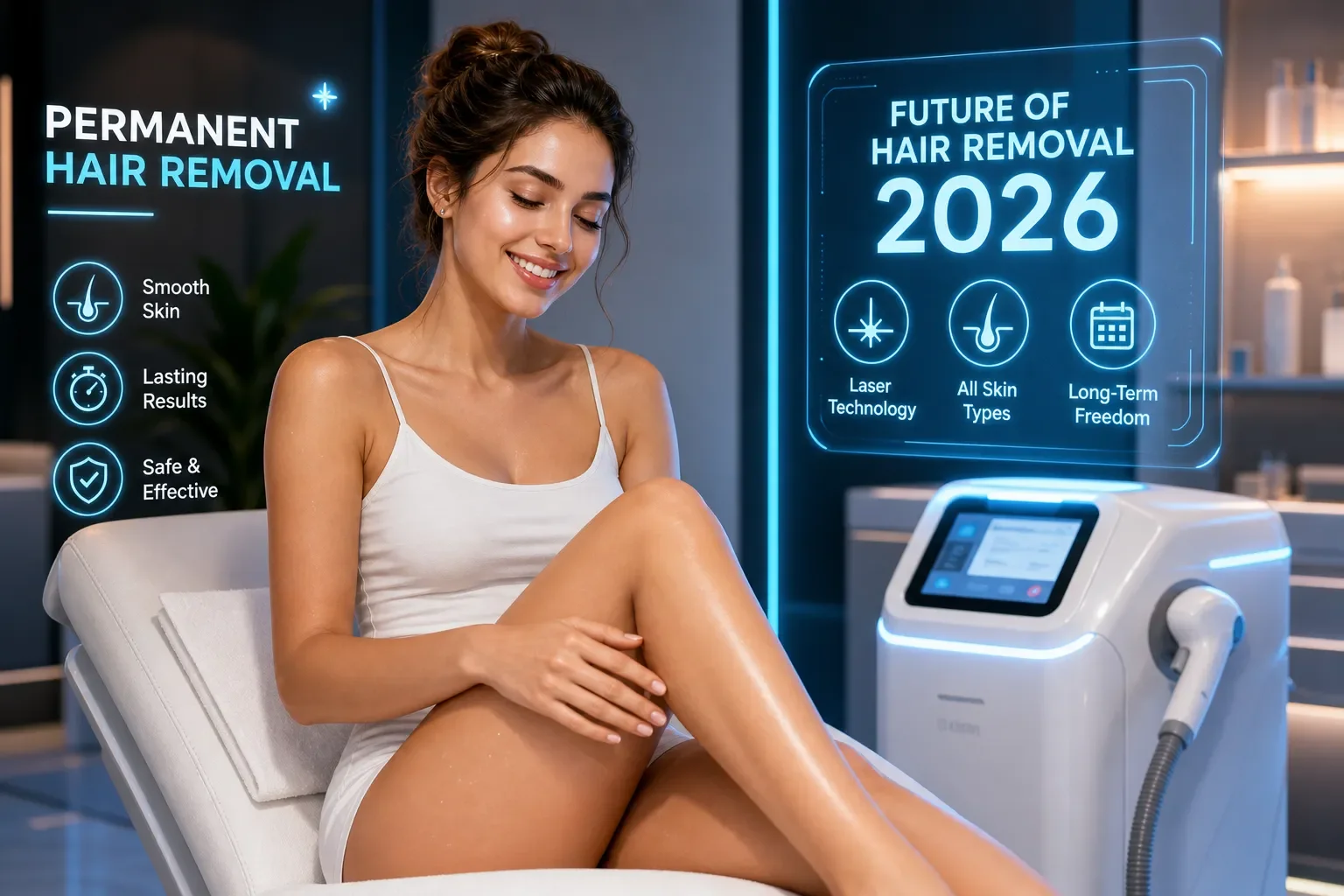
Concentrated light is absorbed by the melanin pigment in the hair shaft, converting to heat that damages the follicle and significantly reduces future growth. It is fast per session, effective across large body areas, and produces results that last months to years. It works best when there is a strong contrast between dark hair and lighter skin, though modern clinic lasers, including Nd:YAG technology, can treat a wider range of skin tones safely in experienced hands. Most people need between 6 and 8 initial sessions, with maintenance possible afterward depending on individual response.
IPL (Intense Pulsed Light)
IPL uses broad-spectrum light rather than a focused laser beam. It covers large areas quickly and is widely available, but it is less precise than laser and generally produces less consistent results. It also carries higher risk on darker skin tones because the scattered light is harder to control. For the right candidate, typically light skin with dark hair, IPL can achieve meaningful reduction, but it is far less versatile than laser across different skin types. Clinical IPL also differs significantly from at-home consumer devices in terms of power output and built-in safety controls.
Electrolysis
Because electrolysis destroys individual follicles one at a time, it is slower and more time-intensive than laser or IPL. Sessions for a small area like the upper lip can run 15 to 30 minutes per appointment across many months. The trade-off is significant: electrolysis works on any hair colour, including blonde, grey, red, and white, and any skin tone, because it does not rely on melanin contrast at all. For people with light or difficult-to-treat hair, or for those with darker skin who are not suitable candidates for laser, electrolysis is often the most effective long-term solution available.
At-home IPL devices
Consumer IPL devices are lower power by design, require more sessions, and produce less complete results than professional treatments. Small studies have shown roughly 70% to 80% reduction in suitable candidates, but the evidence base is considerably thinner than for professional systems, and these devices work reliably only on a narrow range of skin and hair types. There is also a genuine risk of burns, pigment changes, and eye injury when used incorrectly. The upfront cost looks appealing, but the results rarely match what a qualified clinic delivers, particularly over the long term.
Does it work for your skin tone and hair colour?
The melanin problem with light-based treatments
Laser and IPL both rely on melanin in the hair shaft to absorb light energy and convert it to heat. This means they are most effective on dark, coarse hair against lighter skin. People with blonde, grey, red, or white hair will see little to no result from laser or IPL regardless of how many sessions they complete, because there simply isn't enough pigment in the hair to absorb the energy. People with darker skin tones face a different problem: higher risk of burns, hyperpigmentation, and hypopigmentation if the wrong device, wavelength, or settings are applied. Fitzpatrick skin types IV to VI require specialist equipment, precise settings, and a practitioner who understands the clinical implications of treating darker skin, for more detailed clinical evidence on Nd:YAG use in darker skin, see this Nd:YAG study in Fitzpatrick IV, VI.
Who gets results and who needs a different approach
Electrolysis sidesteps the melanin problem entirely. It works on any skin tone and any hair colour because the electrical current destroys the follicle directly, without depending on pigment contrast. If you have light or grey hair, darker skin, or a combination that rules out laser or IPL, electrolysis deserves serious consideration. It is also worth noting that a clinical skin assessment before any light-based treatment is not an optional extra. It is the step that determines whether laser or IPL is appropriate for you at all, and a reputable clinic will insist on it before you begin.
How many sessions does it take, and what does it cost?
Realistic treatment timelines per method
Laser hair removal typically requires 6 to 8 initial sessions spaced 4 to 8 weeks apart depending on the body area, with maintenance sessions possible every 6 to 12 months afterward for some people. Underarms and bikini areas usually fall within the 6 to 8 session range; full legs may require 8 to 10. Electrolysis requires more frequent, shorter appointments over a longer overall period, often 12 to 18 months for complete results on a single area. At-home IPL devices are typically used weekly or fortnightly for several months before results stabilise, and those results are less complete than what a clinic produces.
What to expect from clinic costs versus at-home devices
Professional laser hair removal at a UK clinic typically costs between £60 and £200 per session depending on the body area and clinic, with full courses often sold as packages. A typical 6-session course for a small to medium area runs roughly £360 to £1,200; full-body packages at some UK clinics are quoted in the region of £1,500 to £2,000. At-home IPL devices range from £100 to £400 upfront, which looks like a bargain until you factor in the quality and longevity of what they actually deliver. The cost comparison looks very different when you weigh results, not just receipts.
The safety risks that don't get enough attention
What can go wrong with laser, IPL and electrolysis
All three professional methods carry some level of risk. Common side effects include redness, swelling, and temporary skin irritation. More serious complications include blistering, burns, scarring, hyperpigmentation, and hypopigmentation, particularly when settings are inappropriate for the skin type being treated. IPL on darker skin without careful calibration can cause significant pigment damage that takes months to resolve. Laser and IPL also carry ocular injury risk without proper eye protection, and both can trigger cold sore reactivation on facial areas in people with a history of HSV. Electrolysis, while the most universally applicable method, can cause scarring, infection, and pigment changes if performed poorly.
Why the practitioner matters more than the technology
The risks above are not inherent to the treatments themselves. They are largely the result of undertrained practitioners, unsuitable equipment, or a missing clinical assessment. A medically qualified provider will assess your Fitzpatrick skin type, review your medical history, check for contraindications, adjust device settings accordingly, and know when not to treat. Photosensitising medications, recent sun exposure, melasma, and several other factors all affect treatment safety, and they require a clinical lens to identify properly. The technology being used at a clinic is only as safe as the person operating it, which is why the practitioner's qualifications are the most important variable in the whole equation.
Why choosing a medically qualified clinic changes the outcome
What clinical-grade permanent hair removal looks like in practice
At a Nurse Prescriber-led clinic, laser hair removal begins with a full clinical consultation, not a quick patch test and a booking form. Your skin type, hair colour, medical history, medications, and treatment goals are all assessed before a single session is planned. Device settings are calibrated specifically for you, which is what produces better results and a safer experience. It also allows a practitioner to identify when a different permanent hair removal method would serve you better than the one you originally enquired about. Making that call requires real clinical knowledge, not just operating familiarity with a machine.
MAK Clinic's approach to laser hair removal in Cheshire
At MAK Clinic in Knutsford, Cheshire, laser hair removal is delivered by practitioners with extensive medical training. The clinic was founded by Jennifer, an Aesthetic Nurse Prescriber with 20 years of clinical experience and advanced training from internationally recognised doctors and surgeons. Every patient receives a detailed clinical assessment before treatment begins, with device settings matched to the individual rather than drawn from a standard protocol. Clients travel to the clinic from Wilmslow, Altrincham, Alderley Edge, Hale, and across the wider Cheshire area because they want medical-grade treatment with proper oversight, not a beauty-therapy-level service with clinical branding layered over it.
For anyone weighing up their options and wanting to avoid the risks that come with less qualified providers, a consultation at MAK Clinic is the logical first step, and our LASER & IPL treatments blog covers many common clinical questions in more detail. The difference in experience, safety, and outcome between a medically qualified clinic and a salon environment is not marginal. It is substantial.
The bottom line on permanent hair removal in 2026
The term gets used loosely, and understanding what each method actually delivers is the foundation of any good decision. Electrolysis remains the only truly permanent option recognised as such by regulatory bodies, effective across all skin tones and hair colours. Laser offers reliable, long-lasting reduction and is the most practical permanent hair removal choice for most people with suitable skin and hair types, provided expectations are set correctly from the start.
The method matters. The practitioner and clinical setting matter just as much. A clinic with advanced technology and an undertrained operator is a risk; one with medically qualified staff who conduct proper assessments is where results and safety come together. Don't default to the cheapest or most convenient option. Default to the one where someone with real clinical credentials is accountable for your outcome.
If you're based in Knutsford, Wilmslow, Altrincham, or anywhere across Cheshire and you're ready to explore your options properly, book a consultation at MAK Clinic. You'll get a straight answer about what will actually work for your skin and hair type, based on clinical assessment rather than what's easiest to sell you. For further reading and patient-focused articles, see our laser hair removal blog.
Permanent Hair Removal FAQs
-
At Medical Aesthetics Knutsford (MAK Clinic), we are more than just a clinic; we are pioneers in the aesthetic treatment industry with a commitment to excellence that spans over two decades.
Based in Knutsford, MAK Clinic is easily accessible from Manchester and surrounding Cheshire areas, including Alderley Edge, Macclesfield, Wilmslow, Northwich and Hale.
MAK Clinic only uses the highest-quality Botulinum Toxin and filler products, including Juvederm, Belotero, Restylane, and Teosyal.
MAK Clinic exclusively uses the highest quality, regulated products, and our registered healthcare practitioners perform all procedures.
Founded by Jennifer Dowdall - RGN INP, all treatments are performed or overseen by Nurse Prescriber Practitioners, ensuring the highest standards of medical safety and expertise.
Read more about your aesthetics practitioner, Jennifer or more about MAK Clinic. Read our latest reviews or get in touch.
-
You can book a consultation for the Permanent Hair Removal treatment using the Book Now page or the universal "Book Now" button at the bottom right of every web page.
During the booking process, you can find the pricing for the Permanent Hair Removal treatment and the value-added complementary therapies that enhance its effectiveness.
If you need clarification on something, please feel free to book a consultation with us first so that we can talk about your goals and a personalised treatment plan.
-
Yes, but only through electrolysis. Every other method, including laser and IPL, produces long-lasting reduction rather than complete, permanent removal. Electrolysis is the one technique classified as truly permanent by the FDA and equivalent regulatory bodies.
-
It depends on the method and area. Laser typically requires 6 to 8 initial sessions; electrolysis often takes 12 to 18 months of regular appointments to complete a single area. Both require patience, but the long-term payoff is significant compared to ongoing shaving or waxing.
-
Laser and IPL carry higher risk on darker skin if the wrong equipment or settings are used. Electrolysis is safe for all skin tones. For darker skin types considering laser, it is essential to use a practitioner with specialist experience and appropriate technology, such as Nd:YAG.
-
Electrolysis. Laser and IPL rely on melanin in the hair shaft to work, so they produce little to no result on blonde, grey, red, or white hair. Electrolysis destroys the follicle directly and works regardless of hair colour.