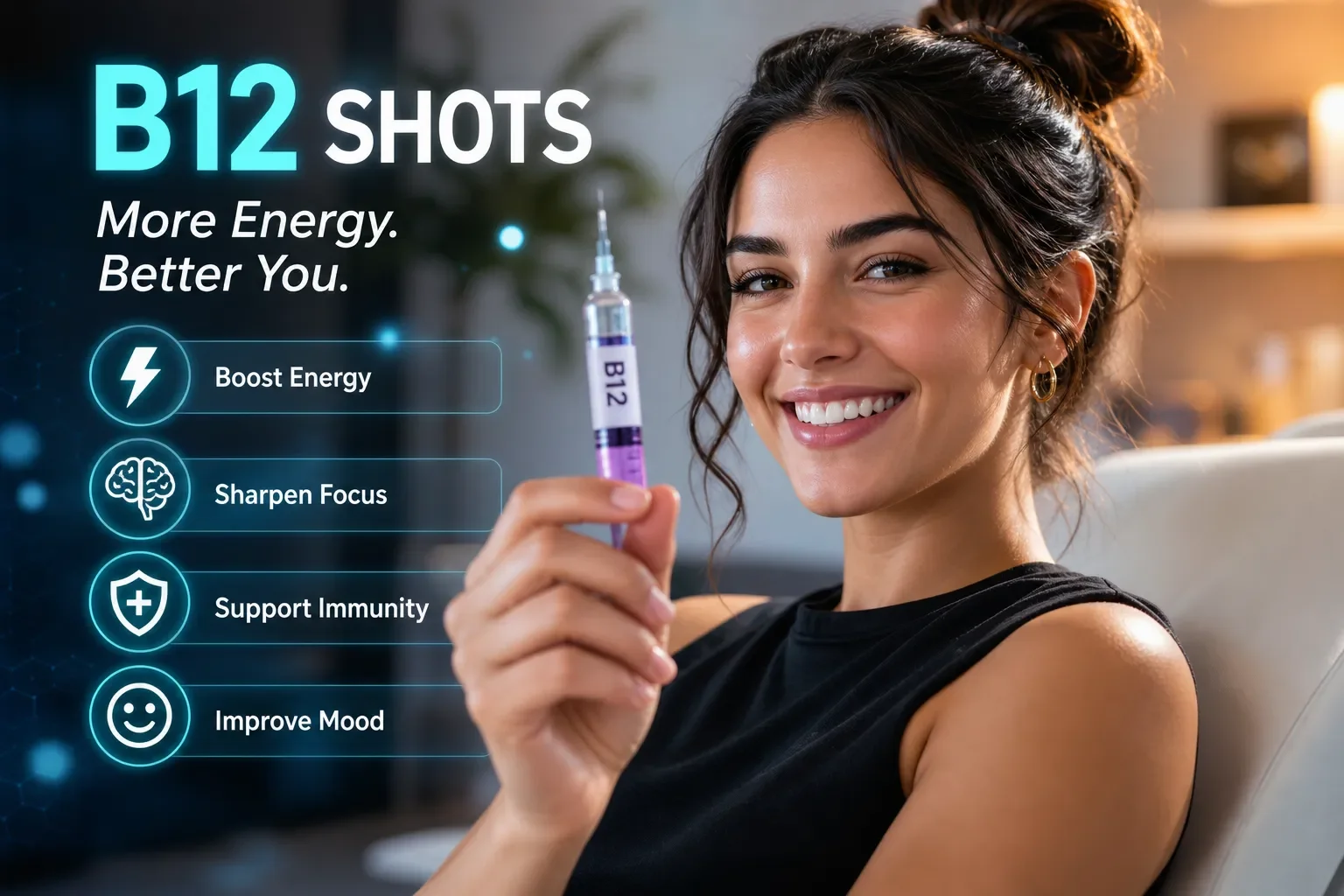
B12 shots are having a moment. Some commercial clinics and wellness outlets are selling them as a fix for fatigue, brain fog, and low mood, often with minimal clinical assessment beforehand. Some of that enthusiasm is justified; most of it is not, and understanding the difference is exactly what this article is for.
At MAK Clinic in Knutsford, the story we hear most often goes like this: a patient has been exhausted for months, sometimes years. They have tried better sleep, improved their diet, cut back on alcohol. Nothing shifts it. Nobody has ever properly checked their B12 levels. When we do, the picture becomes clear very quickly. For those patients, a correctly administered B12 injection course can genuinely change how they feel day to day. But that only holds when deficiency is the underlying problem. For someone with normal B12 levels, the evidence simply does not support the same outcome.
This article gives you the real picture of B12 shot benefits: what the clinical evidence actually supports, who genuinely gains from injections, how they compare with oral supplements, and what to expect from treatment.
B12 shot benefits: what the evidence actually says
The strongest clinical evidence for vitamin B12 injections sits in one specific place: confirmed deficiency. The benefits below are real, but they are most pronounced when low B12 is the documented problem. These are not cobalamin shot advantages available to everyone, they apply most clearly when deficiency is driving the symptoms.
Energy and fatigue: the honest answer
Fatigue is the most common reason people seek out B12 injections, and the evidence here demands honesty. For people with confirmed deficiency, injections can produce a meaningful improvement in energy within weeks because B12 is essential for red blood cell production and cellular energy metabolism. Without adequate B12, your cells cannot generate energy efficiently, and the result is the kind of bone-deep tiredness that sleep does not fix.
For people with normal B12 levels, the clinical picture is different. Systematic reviews and randomised trials have not demonstrated consistent benefit from B12 injections in non-deficient individuals, and the energy boost some people report in this group is not well supported by the evidence. That distinction matters, because it means the first question you should be asking is not "how do I get a B12 shot?" but "do I actually need one?"
Neurological health and mood support
This is where the clinical evidence is particularly compelling. B12 is critical for maintaining the myelin sheath, the protective coating around nerve fibres, and deficiency causes measurable neurological damage over time. Peripheral neuropathy, pins and needles, balance problems, and cognitive changes are all recognised consequences of prolonged B12 deficiency. When deficiency is the underlying cause, evidence supports genuine improvement in these symptoms following injection therapy.
Mood disruption is also associated with low B12 through its involvement in methylation pathways that influence neurotransmitter metabolism; clinically, mood benefit is clearest when deficiency is present. There is also evidence from systematic reviews suggesting that B12 supplementation can reduce neuropathic pain in diabetic neuropathy. The key qualifier throughout is the same: the benefit is clearest when deficiency is confirmed and driving the symptoms.
Anaemia recovery
B12 deficiency causes megaloblastic anaemia, a condition where red blood cells grow abnormally large and cannot function properly. This is one of the best-documented indications for B12 deficiency treatment in clinical literature. Resolving this type of anaemia with a correctly managed injection course typically takes around six to eight weeks, and the haematological response is reliable and well established. Left untreated, megaloblastic anaemia can worsen progressively, which is why prompt diagnosis and monitoring are important.
Signs of B12 deficiency most people miss
Deficiency develops slowly, which is precisely why it so often goes undetected. By the time symptoms are noticeable, levels may have been low for months or longer.
Physical symptoms that point to low B12
The clinical signs span several body systems, which is part of why they are easy to attribute to other causes. Persistent fatigue and breathlessness from anaemia are common, as are pins and needles or numbness in the hands and feet, balance or gait problems, a sore red tongue, and recurring mouth ulcers. Cognitive changes, including difficulty concentrating and memory problems, are also recognised features of B12 deficiency. If you have been dealing with any combination of these for a significant period, B12 is worth investigating before assuming the cause is stress or poor sleep.
What your blood test results actually mean
NICE defines B12 deficiency as a serum level below 180 ng/L. There is also an indeterminate zone between 180 and 350 ng/L where deficiency may still be present if symptoms fit, and clinical assessment rather than the number alone should guide the decision. A serum B12 test does not always tell the full story on its own, which is why self-interpreting a single lab result is not a reliable way to decide whether you need treatment. A qualified clinician will consider your symptoms, your risk factors, and potentially additional markers such as serum methylmalonic acid (MMA) and homocysteine alongside the blood test before making a recommendation.
Who genuinely benefits from B12 injections
B12 injections are not for everyone. They deliver the clearest benefit to specific groups, and laying that out plainly is more useful than vague promises.
Medical conditions that make injections necessary
Pernicious anaemia is an autoimmune condition in which the stomach cannot produce the intrinsic factor required to absorb B12 from food. For these patients, oral supplementation cannot compensate for the absorption problem, making injections the only reliable route to maintaining adequate levels. The same applies to other malabsorption conditions including Crohn's disease, coeliac disease, and people who have had bariatric surgery. In cases involving neurological symptoms from confirmed deficiency, injections are also the preferred route because rapid repletion is a clinical priority.
Lifestyle and demographic risk factors
Strict vegans and vegetarians are at higher risk of deficiency because B12 is found almost exclusively in animal products, and dietary intake alone will not maintain adequate levels without supplementation. Adults over 60 face an increased risk due to age-related decline in gastric acid production, which reduces the body's ability to absorb B12 from food. Certain long-term medications also deplete B12 over time, most notably metformin, widely used for type 2 diabetes, and proton pump inhibitors prescribed for acid reflux. If you fall into any of these categories, regular monitoring is worth discussing with your GP or a qualified clinician.
B12 shot benefits vs oral supplements: an honest comparison
This is where many clinics oversell injections. Here is a straight comparison of intramuscular B12 vs oral B12, based on the clinical evidence.
When high-dose oral B12 is genuinely sufficient
For many patients with mild to moderate deficiency where the gut absorbs B12 normally, clinical trials show that high-dose oral B12 (1,000 to 2,000 mcg daily) achieves comparable results to intramuscular injections within one to four months. If the cause of your deficiency is dietary rather than malabsorption, oral supplementation is a practical and effective option that does not require clinic visits. Honest clinical advice sometimes points away from an injection and towards a well-chosen supplement, and that is the advice you will get at MAK Clinic if it is the right call for you.
When injections are the better clinical choice
Injections clearly outperform oral tablets in specific situations: severe neurological symptoms requiring urgent repletion, confirmed malabsorption conditions where the gut cannot absorb B12 regardless of the oral dose, and patients who cannot reliably maintain a daily supplementation routine. The speed advantage of a B12 IM injection is most relevant when repletion needs to happen quickly. This is precisely why the decision between injections and oral supplementation should be made by a qualified clinician after a proper assessment, not self-selected based on convenience or marketing.
What to expect from B12 injection treatment
Here is how B12 injection treatment typically works in UK practice.
Dosage and frequency used in UK practice
The standard UK regimen uses hydroxocobalamin 1 mg administered intramuscularly, in line with NICE and NHS prescribing guidance. For patients with neurological involvement, the loading schedule involves injections on alternate days for two weeks, or until symptoms begin to improve, followed by maintenance doses every two months. Without neurological symptoms, the loading phase is typically three injections per week for two weeks, followed by maintenance every two to three months. Dosage and frequency decisions should always be made by a qualified clinician based on individual assessment, not taken from a generic protocol found online.
How long before you notice the difference
Many patients notice improved energy and general wellbeing within one to two weeks of beginning the loading phase. Anaemia typically resolves within eight weeks, and blood counts improve steadily throughout. Neurological symptoms, depending on their severity and how long they have been present, can take anywhere from six weeks to six months to improve fully. Recovery is not linear and it is not the same for everyone, which is why ongoing monitoring matters rather than a single injection followed by no follow-up.
Side effects, safety, and why clinical setting matters
B12 injections are generally well tolerated, but that does not mean they are without risk, and being informed before treatment is reasonable.
Common reactions vs warning signs
Typical side effects include mild pain, redness, or swelling at the injection site, along with occasional nausea, headache, or flushing. These are normal and short-lived. The warning signs to take seriously include hives, facial or throat swelling, wheezing, or difficulty breathing, any of which indicate a potentially serious allergic reaction requiring immediate medical attention. Contraindications include allergy to cobalt or cyanocobalamin and Leber's disease, an inherited optic nerve condition. People taking anticoagulants should flag this before treatment, as there is a documented bleeding risk associated with concurrent use. Rare but reported risks include hypokalaemia and peripheral vascular thrombosis in people with certain underlying conditions.
Why professional administration changes the outcome
A B12 injection administered by a medically qualified practitioner is a different proposition to one offered without a prior assessment. At a nurse prescriber-led clinic like MAK Clinic, every patient receives a thorough clinical review before any injection is given. That means the dose, frequency, and route are determined by what the individual patient actually needs, not by a generic protocol applied to everyone who walks through the door. That clinical layer is what separates a genuinely beneficial treatment from one that is simply repeated without purpose or proper monitoring.
Start with the facts, then make a decision
The B12 shot benefits that the evidence supports are real and meaningful, but only when injections are used for the right reasons. If you are experiencing persistent fatigue, neurological symptoms, or you belong to a high-risk group, the first step is a proper blood test and clinical assessment, not a self-prescribed top-up.
For people with confirmed deficiency, a correctly managed B12 booster shot course can restore energy, support neurological recovery, and resolve anaemia in a way that makes a genuine difference to daily life. The evidence for that is solid. The evidence for injections as a general wellness treatment for people with normal B12 levels is not. Start with the evidence, get assessed by someone qualified, and make the decision from there.
If you are based in Cheshire or the surrounding area and want a proper clinical assessment before committing to any treatment, you can book a consultation at MAK Clinic in Knutsford. The conversation starts with your health, not a sales pitch.
B12 Shots FAQs
-
At Medical Aesthetics Knutsford (MAK Clinic), we are more than just a clinic; we are pioneers in the aesthetic treatment industry with a commitment to excellence that spans over two decades.
Based in Knutsford, MAK Clinic is easily accessible from Manchester and surrounding Cheshire areas, including Alderley Edge, Macclesfield, Wilmslow, Northwich and Hale.
MAK Clinic only uses the highest-quality Botulinum Toxin and filler products, including Juvederm, Belotero, Restylane, and Teosyal.
MAK Clinic exclusively uses the highest quality, regulated products, and our registered healthcare practitioners perform all procedures.
Founded by Jennifer Dowdall - RGN INP, all treatments are performed or overseen by Nurse Prescriber Practitioners, ensuring the highest standards of medical safety and expertise.
Read more about your aesthetics practitioner, Jennifer or more about MAK Clinic. Read our latest reviews or get in touch.
-
You can book a consultation for the B12 Shots treatment using the Book Now page or the universal "Book Now" button at the bottom right of every web page.
During the booking process, you can find the pricing for the treatment and the value-added complementary therapies that enhance its effectiveness.
If you need clarification on something, please feel free to book a consultation with us first so that we can talk about your goals and a personalised treatment plan.