Mole removal in the UK: options, costs and aftercare
Mole removal sounds like a simple booking. In practice, it rarely is. Before you even think about which clinic to call, there is one question that changes every decision that follows: is this mole a medical concern or a cosmetic one?
Get that wrong and you either end up bypassing a clinical pathway that could catch something serious, or you spend months waiting on an NHS list for something a private clinic could safely resolve in a single appointment.
Whether your GP has flagged something, or you simply have a raised mole that keeps catching on your collar, the process you should follow, the cost you will likely pay, and the questions you need to ask your practitioner are all quite different. Nurse Prescriber-led clinics like MAK Clinic in Knutsford, Cheshire, begin every mole removal consultation with a thorough clinical evaluation for exactly this reason. That evaluation is not a formality; it is the decision. This guide will give you a clear picture of methods, costs, and recovery before you commit to anything.
When a mole needs a professional opinion before removal
Most people researching mole removal are thinking about a cosmetic nuisance, not cancer. That is absolutely fine. But it is worth spending five minutes running through the basics before you book, because the occasional mole that does warrant medical attention tends to look, at first glance, like just another cosmetic concern.
The ABCDE checklist and what the signs actually mean
Clinicians use five characteristics to flag a potentially problematic mole. Asymmetry means one half of the mole does not mirror the other. Border irregularity means the edges are ragged, notched, or blurred rather than smooth and defined. Colour variation means you can see multiple shades within the same mole, including brown, black, tan, white, red, or even blue. Diameter over 6mm is worth noting, although smaller moles can still be problematic. Evolving is the most important of the five: any mole that has changed in size, shape, colour, or texture in recent months deserves attention.
Any single feature on that list is enough to warrant mentioning to a GP, you do not need to tick all five boxes before seeking an opinion. A mole that is actively changing demands urgent attention.
When to contact your GP rather than a private clinic
Go to your GP first if a mole has changed size, shape, or colour; if it bleeds, itches, or crusts; or if a new mole has appeared in adulthood that simply looks different from the others. These are the situations where a mole biopsy and histological analysis may be needed, and that requires a medically supervised NHS pathway. Reputable private removal clinics, however thorough their pre-treatment review, should not be your first port of call when something looks suspicious. The investigation comes before the removal decision.
What separates a cosmetic mole from a concern
A genuine cosmetic candidate is a mole that has been stable for years, is uniform or near-uniform in colour, and has no history of bleeding, itching, or rapid change. Ideally it has already been looked at by a GP or dermatologist at some point. If your mole fits that profile and you simply want it gone because it catches on jewellery or you dislike the look of it, you are in the right territory for a cosmetic mole removal consultation.
NHS versus private mole removal: what you are actually entitled to
The NHS does not remove moles on request. That surprises a lot of people who assume they can simply ask their GP to refer them for something they dislike the look of. The reality is more nuanced than that.
What the NHS will and will not treat
Suspicious or potentially cancerous moles receive an urgent two-week-wait referral to a dermatologist under the suspected cancer pathway. That system works well and is appropriately fast. For benign moles, NHS removal is only offered when there is a specific medical reason: repeated bleeding during normal daily activity, recurrent infection requiring antibiotics more than once a year, significant pain requiring ongoing treatment, or obstruction to an orifice or interference with vision. Purely cosmetic mole removal falls outside NHS scope at most trusts.
How much private mole removal costs in the UK
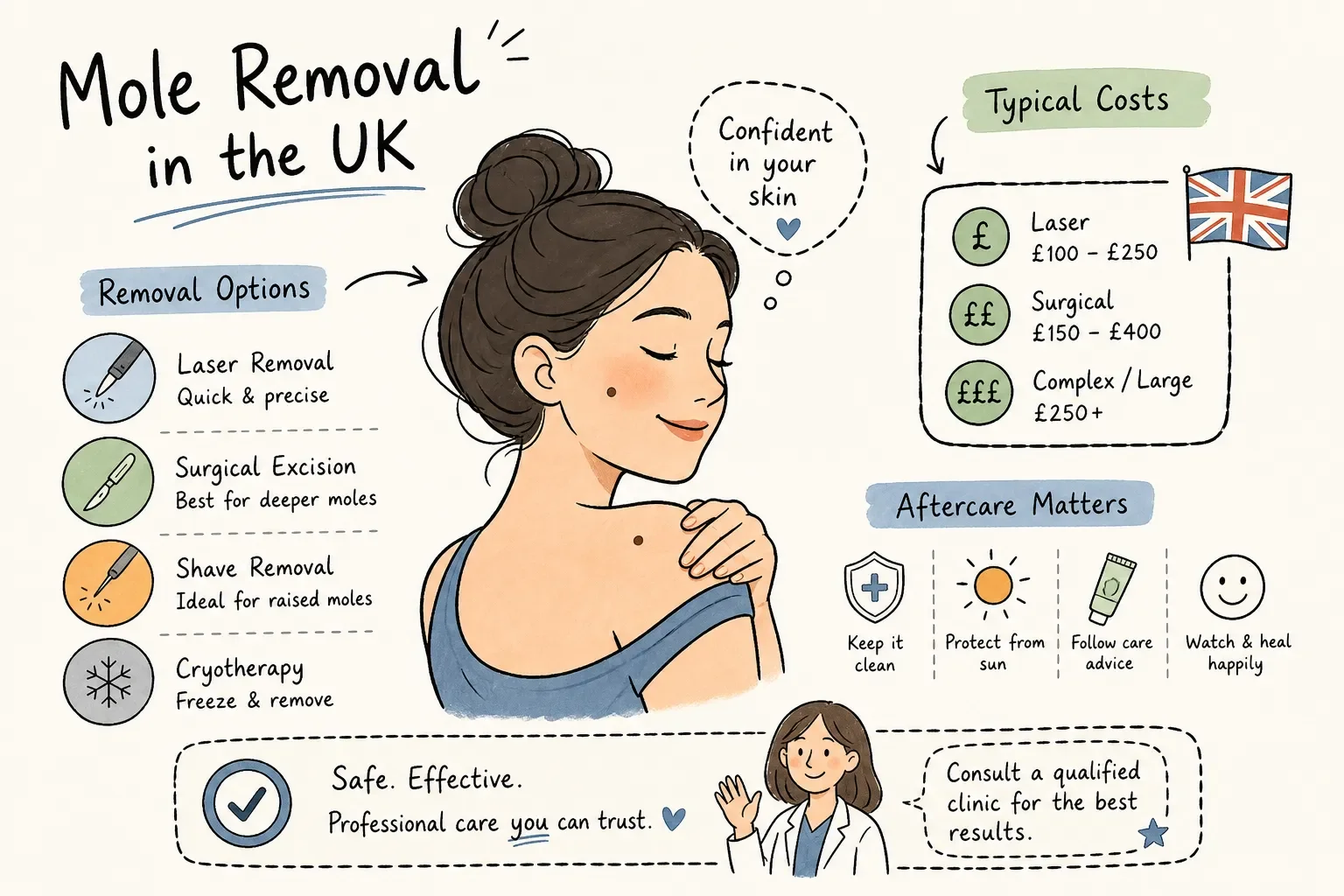
Private pricing varies by method, clinic location, and whether histology is included. As a general guide, shave excision typically runs from £200 to £350. Full surgical excision, also referred to as mole excision, sits between £300 and £500. Laser removal costs between £150 and £300 per session. Plasma soft surgery is priced comparably to shave excision in most clinics. Standalone mole check consultations are often charged separately, typically between £150 and £350. London and specialist clinics tend to charge more, particularly when mole biopsy and histology are bundled into the procedure cost.
Is a pre-treatment mole check worth paying for?
Yes, without question. A standalone mole check at a reputable private clinic gives you professional reassurance before any removal decision is made. It either confirms the mole is safe to remove cosmetically, letting you proceed with confidence, or it identifies something that needs a different clinical pathway altogether. If you are bypassing the NHS route, a thorough pre-treatment assessment is essential. Any clinic that will remove a mole without first examining it properly is not a clinic worth using.
Cosmetic mole removal methods: what each one involves
There are four main methods in routine use across UK private clinics. Each has different clinical indications, scarring profiles, and limitations. Understanding the trade-offs helps you ask the right questions at your consultation.
Surgical excision: the most thorough option
Surgical mole excision involves cutting out the entire mole with a small margin of surrounding skin, then closing the wound with sutures. It is the preferred method for deeper moles, larger lesions, or any mole where histology is needed to rule out malignancy. The trade-off is a linear scar and a slightly longer healing period, but recurrence rates are the lowest of any method and the removed tissue can be analysed under a microscope. For any mole with suspicious features, this is the appropriate route.
Shave excision: a faster route for raised benign moles
Shave excision uses a blade to remove a raised mole flush with the skin surface, usually without stitches. It heals faster, tends to leave a less prominent scar than full excision, and is well-suited to superficial benign lesions. The limitation is that it does not capture deep margins, so it is unsuitable for any mole with suspicious features. Because the technique removes the surface tissue rather than excising the whole structure, deep recurrence is possible, and the method does not produce a reliable specimen for pathology.
Plasma soft surgery: a modern approach for cosmetic removal
Plasma soft surgery uses ionised gas to precisely ablate tissue without a blade. It works by sublimating the target tissue, which dries into a scab and falls away as the skin heals beneath. It is increasingly offered by nurse-led aesthetics clinics for the cosmetic removal of benign moles, particularly flat or slightly raised lesions, and results can be excellent when the mole is genuinely benign and the practitioner carries out a proper practitioner assessment beforehand. At MAK Clinic in Knutsford, plasma soft surgery for mole removal is only performed after a full evaluation by the clinic's Aesthetic Nurse Prescriber, which is exactly the standard the technique requires.
Like shave excision, plasma soft surgery does not produce a tissue specimen for pathology. This is why the prior assessment step is so critical. The procedure is appropriate for confirmed benign cosmetic lesions; it is not appropriate for anything that has not been properly evaluated first.
Laser removal and cryotherapy: when they are appropriate
Laser uses focused light energy to break down pigment cells in small, flat, cosmetic moles. Cryotherapy for moles freezes the tissue with liquid nitrogen. Both methods destroy tissue rather than excise it, so neither produces a sample for biopsy. They are best suited to clearly benign, cosmetically bothersome lesions where the clinical picture is unambiguous. Recurrence rates can be higher than with excision, and laser may require more than one session to achieve the desired result.
What the removal procedure actually involves
Knowing what to expect on the day removes most of the anxiety around the procedure itself. The process is straightforward, but it does involve a few distinct stages.
The pre-treatment assessment: what a thorough practitioner does first
A responsible clinic will assess the mole before any treatment is agreed. That means examining its size, shape, colour, texture, and history. Some clinics use dermoscopy for closer inspection of the structure beneath the surface. The practitioner should ask about any changes over time, personal or family history of skin cancer, and current medications. If anything raises a flag during the assessment, the ethical response is to refer rather than treat. This evaluation is not box-ticking; it is the foundation of a safe outcome.
The procedure itself: timeline and sensation
Most mole removal procedures are performed under local anaesthetic and take between 15 and 45 minutes depending on the method. Plasma soft surgery and shave excision are typically the quickest. Surgical excision takes a little longer and involves suturing. Expect a brief sting from the anaesthetic injection, followed by minimal sensation during the removal itself. Your practitioner will clean and dress the area before you leave.
The first 48 hours: what your skin will look like
Redness, mild swelling, and some tenderness are normal immediately after treatment. The treated area may look raw or slightly crusted depending on the method used. Some oozing is expected, but active bleeding should be minimal. You will typically be advised to keep the dressing dry for the first 24 to 48 hours, and the clinic should give you written aftercare instructions to follow from that point.
Mole removal aftercare: the timeline that protects your result
The procedure itself takes less than an hour. How well you look after the wound over the following weeks determines how the scar heals. This part matters more than most people realise.
Days 1 to 14: protecting the wound as it closes
Keep the initial dressing dry for the first 24 to 48 hours. After that, gentle showering is usually fine, but avoid baths, swimming pools, hot tubs, and saunas until the wound is fully closed, which typically takes two to three weeks. Change dressings daily or as instructed by your clinician. Wash your hands before touching the area and pat dry rather than rubbing. Do not pick at scabs, apply retinol or acids near the wound, or use makeup directly over the site.
Weeks two to eight: supporting healthy scar formation
Once the surface skin has closed, scar management can begin. Silicone gel or silicone sheets have the strongest clinical evidence behind them for minimising scar tissue and are worth starting as soon as your clinician confirms the wound has closed properly. Sutures are typically removed between five and fourteen days after the procedure, with facial wounds on the shorter end of that range and body wounds on the longer end. Gentle massage of the area can also support healing once closure is confirmed.
Sun protection and the long game for scars
A fresh scar is vulnerable to UV-induced pigment changes for up to twelve months after treatment. Apply SPF 30 to 50 on the area whenever it will be exposed to daylight, and avoid direct sun on the site for at least the first three months. This is the single most overlooked step in mole removal aftercare, and it has the greatest long-term impact on how visible the final scar remains.
How to choose the right clinic and the questions worth asking
The method and the aftercare both count, but neither compensates for a practitioner who lacks the clinical judgement to know when not to treat.
What qualifications should your practitioner have?
Mole removal in the UK sits in a grey regulatory area outside the NHS. For plasma soft surgery or shave excision, look for a practitioner with prescribing authority or a medical background, formal training in the specific technique used, and a clear policy of clinical assessment before any treatment proceeds. A Nurse Prescriber-led clinic offers a level of medical oversight that most beauty salon-based providers cannot match. MAK Clinic in Knutsford, led by an Aesthetic Nurse Prescriber with two decades of full-time clinical experience, represents the standard you should be benchmarking any Cheshire-based provider against.
Questions to ask before you commit to any removal clinic
Before you book, ask these questions directly:
Do you perform a clinical assessment before agreeing to treat, and what does that involve?
Will the tissue be sent for histology if excision is used?
What is your referral pathway if something looks suspicious during the assessment?
What aftercare support is included and how do I contact you if I have concerns?
Have you treated this type of mole before and what results should I realistically expect?
Those five questions will quickly separate a thorough clinic from one that treats mole removal as a routine cosmetic appointment with no clinical gatekeeping whatsoever.
Know your mole before you remove it
Run the ABCDE checklist, speak to your GP if anything looks suspicious, and book a clinical assessment at a qualified private clinic before any removal decision is made. That sequence makes the difference between a safe, clean result and an avoidable risk. For anything with diagnostic uncertainty, surgical mole excision is the right choice because it produces tissue for analysis. For confirmed benign lesions, plasma soft surgery and shave excision are effective and well-tolerated. Laser and cryotherapy suit the right cosmetic candidates when the clinical picture is clear.
Do not underestimate the aftercare. Sun protection for up to twelve months post-procedure has more impact on your final scar than almost any other variable. Starting silicone gel as soon as the wound closes, and keeping the site protected from UV in those first critical months, rounds out a straightforward but effective recovery plan.
If you are based in Cheshire and want a medically thorough approach to mole removal, a Nurse Prescriber-led clinic like MAK Clinic starts every consultation with exactly the kind of rigorous clinical evaluation this guide has described. That is where a safe, well-considered removal begins.
Mole Removal FAQs
-
At Medical Aesthetics Knutsford (MAK Clinic), we are more than just a clinic; we are pioneers in the aesthetic treatment industry with a commitment to excellence that spans over two decades.
Based in Knutsford, MAK Clinic is easily accessible from Manchester and surrounding Cheshire areas, including Alderley Edge, Macclesfield, Wilmslow, Northwich and Hale.
MAK Clinic only uses the highest-quality Botulinum Toxin and filler products, including Juvederm, Belotero, Restylane, and Teosyal.
MAK Clinic exclusively uses the highest quality, regulated products, and our registered healthcare practitioners perform all procedures.
Founded by Jennifer Dowdall - RGN INP, all treatments are performed or overseen by Nurse Prescriber Practitioners, ensuring the highest standards of medical safety and expertise.
Read more about your aesthetics practitioner, Jennifer or more about MAK Clinic. Read our latest reviews or get in touch.
-
You can book a consultation for the Mole Removal treatment using the Book Now page or the universal "Book Now" button at the bottom right of every web page.
During the booking process, you can find the pricing for the treatment and the value-added complementary therapies that enhance its effectiveness.
If you need clarification on something, please feel free to book a consultation with us first so that we can talk about your goals and a personalised treatment plan.
-
Private mole removal costs vary by method and clinic location. Shave excision typically costs between £200 and £350, surgical excision between £300 and £500, and laser removal between £150 and £300 per session. London and specialist clinics generally charge more, particularly when histology is included.
-
All mole removal methods carry some risk of scarring. Surgical excision leaves a linear scar, while shave excision and plasma soft surgery typically result in a smaller, rounder mark. Careful aftercare, particularly silicone gel use and diligent sun protection for up to twelve months, significantly reduces how visible the final scar becomes.
-
A mole biopsy is needed whenever a lesion shows suspicious features: asymmetry, irregular borders, multiple colours, a diameter over 6mm, or any recent change in appearance. If your GP or practitioner flags any of these during an assessment, surgical excision with histological analysis of the tissue is the appropriate pathway, not cosmetic removal.