You're not overweight. You eat well, you exercise regularly, and by most measures you're in good shape. But there's a pocket of fat, around your lower abdomen, your flanks, or your inner thighs, that simply doesn't shift no matter what you do. This is exactly the situation non-surgical fat reduction was designed for.
Cryolipolysis, more commonly called fat freezing, has become an increasingly requested body contouring treatment in the UK, and for good reason: it targets localised fat pockets without surgery, needles, or recovery time.
This article covers the full picture. How the science actually works. Which areas respond well. What results you can realistically expect, and when. How much it costs in the UK. The risks, including one rare complication that deserves more transparency than it usually gets. And how to choose a clinic you can genuinely trust. At Fat Freezing | Body Contouring with 3D Lipo at MAK Clinic Knutsford, every patient considering 3D Lipo fat freezing starts with a full body contouring assessment, a clinical evaluation, not a sales call. That distinction matters, and by the end of this article you'll understand exactly why.
What fat freezing actually does to your body
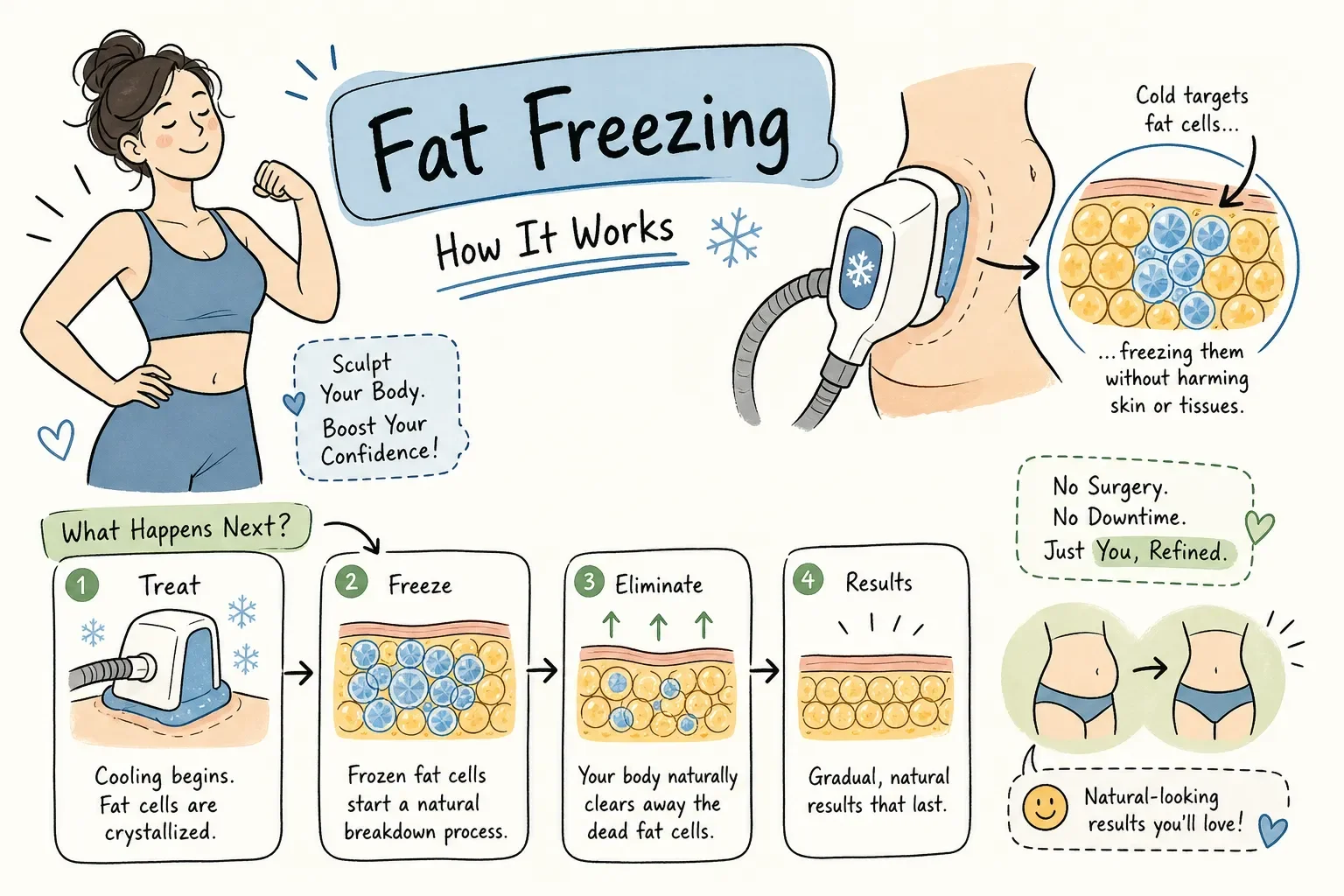
The science behind cryolipolysis is straightforward once you understand one key biological fact: fat cells are more sensitive to cold than the surrounding skin, muscle, and nerves. A handheld applicator uses gentle suction to draw the fatty bulge into a cooling chamber, where the temperature is reduced to approximately 0°C to 4°C. At that range, the fat cells begin to crystallise. The surrounding tissue remains unaffected because it does not freeze at the same threshold. For a clear, clinician-focused explanation of how cryolipolysis works, see a reputable overview on how cryolipolysis is the process of freezing fat here.
Once crystallised, the fat cells undergo apoptosis, programmed cell death. The body then recognises the dead cells as waste and triggers an immune response. Macrophages, a type of white blood cell, move into the treated area and gradually break down the dead fat cells, which are then cleared through the lymphatic system over the following weeks and months. There is no surgery, no anaesthesia, and no downtime. The fat is physically destroyed and permanently removed from the body through a natural biological process.
The most commonly treated areas include the abdomen, flanks (often called love handles), inner and outer thighs, upper arms, back fat, the bra-line area, and underneath the chin. The key word here is "pinchable." Fat freezing works on discrete, isolated pockets of subcutaneous fat that you can physically grasp between your fingers. It is not designed to reduce general weight across the whole body. Larger areas like the abdomen often require more than one applicator per session to cover the full treatment zone.
Results you can realistically expect
Clinical data consistently shows an average fat reduction of around 20 to 25 per cent per treatment area per session. That translates to a measurable decrease in fat layer thickness and a visible change in contour. It is not a dramatic overnight transformation, but the change in the treated area is real and permanent. The fat cells that are destroyed do not return. Systematic reviews and clinical reports support these outcome ranges, for further reading on clinical outcomes after cryolipolysis see this peer-reviewed analysis here.
The timeline is slower than most people expect. You will not see results in the first few weeks. Most patients begin to notice a difference between six and eight weeks after treatment, as the body continues to clear the dead cells. Full results typically appear at the three-to-six-month mark. Patience is essential. The process cannot be rushed because it depends on the body's own natural clearance system. For a concise patient-facing overview of treatment expectations and timelines, Cleveland Clinic's guidance on fat‑freezing is useful here.
One misconception worth addressing directly: "permanent" does not mean "immune to weight gain." The destroyed fat cells are gone for good, but the remaining fat cells in the same area can still expand if you gain significant weight. Fat freezing reshapes and reduces a localised bulge. It does not change the number on your scales, and it is not intended to. The ideal candidate is someone already close to their target weight with a specific problem area that exercise and diet have failed to shift.
How many sessions you will need
Most people need between one and three sessions per area to reach their desired outcome. Sessions are typically spaced between two and eight weeks apart depending on the protocol and device used. Some areas respond well after a single treatment. The outer thighs and abdomen, which tend to carry larger and deeper fat deposits, often benefit from a second round. There is no universal answer, and any clinic that tells you otherwise before assessing you properly is guessing.
Three factors determine your treatment plan: the size and depth of the fat pocket, the result you are aiming for, and how your individual body responds to the procedure. Your body's response in particular can only be gauged after an initial clinical evaluation, which is why a thorough assessment before your first session is not optional. It is the difference between a realistic plan and a disappointing result. Clinics that sell you a fixed number of sessions without first evaluating your anatomy are not working in your best interest. A good clinic designs the plan around your body, not around a standard pricing package.
Who this treatment is suited for (and who should look elsewhere)
Fat freezing is well-suited to adults at or near a healthy weight who carry stubborn localised fat that has not responded to diet or exercise. People who train consistently and eat a balanced diet but still carry a persistent lower-abdominal bulge or persistent flanks are precisely who this treatment was developed for. It works for both men and women across a broad age range.
There are, however, clear situations where fat freezing is not appropriate. People with cryoglobulinaemia, cold agglutinin disease, or paroxysmal cold haemoglobinuria should not have cryolipolysis, as cold exposure can trigger serious systemic reactions. Those with significant loose or sagging skin rather than an actual fat deposit are likely to see better results from a different approach, such as radio frequency skin tightening, which addresses laxity rather than volume. Pregnancy, active skin conditions over the treatment area, hernias in the target zone, and severe obesity are also contraindications. This is precisely why a proper clinical assessment before booking any treatment is non-negotiable.
If you are considering alternatives to fat freezing, for example, injectable options, be aware that some fat‑dissolving injections have significant safety warnings. For clinic-level information about fat‑dissolving injectables offered in non-surgical settings see our information on Fat Dissolving Injections | Aqualyx at MAK Clinic, and note the FDA's safety advisory about off‑label, non‑approved fat‑dissolving injections here.
Side effects and one complication worth knowing about
Most side effects are mild and short-lived. During the procedure, the treated area typically becomes numb within the first few minutes. Immediately afterwards, the skin may appear red and feel tender, bruised, or swollen. Some people experience a temporary aching sensation in the days that follow as sensation and circulation return to normal. These effects generally resolve within a few days to a couple of weeks, and most people return to their normal daily routine the same day.
There is one complication specific to cryolipolysis that is not discussed as openly as it should be: paradoxical adipose hyperplasia, or PAH. In this rare response, instead of the treated fat reducing, the tissue thickens and hardens into a firm, enlarged mass. Recent meta-analyses estimate the pooled incidence rate at approximately 0.22 per cent, around one in every 455 patients. That is significantly higher than the manufacturer's historically reported rate of 0.025 per cent. PAH does not resolve on its own and typically requires liposuction to correct. The risk appears to be higher with certain machines and, based on available data, may be elevated in male patients, for detailed clinical discussion of PAH incidence see this academic analysis here.
This is not a reason to avoid the treatment. It is, however, a reason to choose your clinic carefully. Using properly maintained, clinically validated equipment and ensuring your practitioner is suitably qualified are the most effective ways to reduce that risk. Transparency about complications before treatment is a mark of a responsible clinic, not a red flag.
How to choose a fat freezing clinic you can trust
Regulation of non-surgical aesthetic treatments in the UK varies considerably and is not equivalent to the oversight applied to surgical procedures. As a result, the bar for who can legally offer fat freezing is lower than many patients realise, patients should check CQC registration and practitioner qualifications carefully. A beauty therapist with a weekend training certificate and a qualified aesthetic nurse practitioner with years of clinical experience can both legally offer this treatment. The difference in safety and outcomes can be significant.
Questions to ask before you book
Before booking, ask these questions directly:
- Is the provider a qualified medical professional, a Nurse Prescriber, aesthetic nurse, or doctor, rather than a beauty therapist?
- Is the clinic registered with the Care Quality Commission (CQC)?
- Which machine does the clinic use, and is it clinically validated?
- What happens if you experience a complication?
What does fat freezing cost in the UK?
Fat freezing in the UK typically ranges from around £450 to £650 for a single applicator treatment, and £800 to £1,200 for two areas treated in the same session. Comprehensive treatment packages covering multiple zones can reach £2,500 or more. Be cautious of heavily discounted deals on voucher sites. Low prices can sometimes indicate lower-cost devices or less experienced operators; it is worth asking about the device model and your practitioner's qualifications before committing. This is not a treatment to shop for on price alone.
At MAK Clinic in Knutsford, Cheshire, 3D Lipo fat freezing is delivered within a Nurse Prescriber-led clinic with extensive full-time medical aesthetics experience. Every patient starts with a personalised body contouring assessment, meaning the treatment plan is shaped by your specific anatomy, your goals, and your skin condition, not by what fits neatly into a standard package. For patients travelling from Wilmslow, Altrincham, Alderley Edge, and across the wider Cheshire and North West area, that level of clinical rigour is what makes the difference between a result you are proud of and one that falls short.
The bottom line
Fat freezing (cryolipolysis) is a clinically evidenced, non-surgical approach to reducing localised fat pockets by around 20 to 25 per cent per session. It is not a weight-loss treatment. Results take weeks to months to appear and most people need one to three sessions per area. The risks are manageable, but only when treatment is delivered by a qualified practitioner using appropriate equipment. It works. Done properly.
The best first step is not a booking. It is an honest conversation with a qualified clinical team who will tell you whether the treatment is right for you, what you can realistically expect, and how many sessions your specific anatomy is likely to need. That initial clinical evaluation is worth more than any deal-site discount. You can also read more case studies and practical guides on our fat removal, Blog.
If you are in Cheshire or the surrounding North West and want to explore non-invasive lipolysis with a team you can trust, book a consultation at MAK Clinic and start with the assessment that every good treatment plan depends on.
TREATMENT FAQs
-
At Medical Aesthetics Knutsford (MAK Clinic), we are more than just a clinic; we are pioneers in the aesthetic treatment industry with a commitment to excellence that spans over two decades.
Based in Knutsford, MAK Clinic is easily accessible from Manchester and surrounding Cheshire areas, including Alderley Edge, Macclesfield, Wilmslow, Northwich and Hale.
MAK Clinic only uses the highest-quality Botulinum Toxin and filler products, including Juvederm, Belotero, Restylane, and Teosyal.
MAK Clinic exclusively uses the highest quality, regulated products, and our registered healthcare practitioners perform all procedures.
Founded by Jennifer Dowdall - RGN INP, all treatments are performed or overseen by Nurse Prescriber Practitioners, ensuring the highest standards of medical safety and expertise.
Read more about your aesthetics practitioner, Jennifer or more about MAK Clinic. Read our latest reviews or get in touch.
-
You can book a consultation for the Fat Freezing treatment using the Book Now page or the universal "Book Now" button at the bottom right of every web page.
During the booking process, you can find the pricing for the treatment and the value-added complementary therapies that enhance its effectiveness.
If you need clarification on something, please feel free to book a consultation with us first so that we can talk about your goals and a personalised treatment plan.
-
No. Fat freezing is a body contouring treatment, not a weight loss treatment. It is designed for people who are close to their target weight but have stubborn, pinchable pockets of fat that do not respond well to diet or exercise.
It works best on areas such as the abdomen, flanks, thighs, upper arms, bra-line area and under the chin. If your main concern is general weight loss, a medical weight loss consultation may be more appropriate.
-
Fat freezing results develop gradually because your body needs time to clear the treated fat cells through the lymphatic system.
Most people start to notice changes around 6 to 8 weeks after treatment, with full results usually visible between 3 and 6 months. This slower timeline is normal and is part of how cryolipolysis works.
-
Most people need 1 to 3 sessions per area, depending on the size of the fat pocket, the area being treated and the result they want to achieve.
Some smaller areas may respond well after one session, while larger or deeper areas, such as the abdomen or outer thighs, may need further treatment. A proper body contouring assessment helps create a realistic plan before you start.
-
Fat freezing is generally well tolerated when carried out by a trained practitioner using appropriate equipment. Common side effects include redness, tenderness, swelling, bruising or temporary numbness in the treated area.
There are rare risks, including paradoxical adipose hyperplasia, where treated fat thickens rather than reduces. This is one reason why clinical assessment, clear consent and a qualified provider matter before booking.